Example Exam A
TIP
We suggest not looking at the assignments before you have time to solve them.
1. Entry Requirement
Check if a word from standard input is a palindrome in Haskell
The user will enter a single word to the standard input. Your task is to check if the word is exactly the same when read forwards and backwards, output the answer and exit. If it is, print "palindrome" to standard output, otherwise print "not a palindrome".
Example:
hey
not a palindrome
Exam Solution
main = do
    word <- getLine
    if word == reverse word then
        putStrLn "palindrome"
    else
        putStrLn "not a palindrome"
2. Racket Main Task (15 points)
Check if an
In chess, a knight can move to any square that is two squares away horizontally and one square away vertically, or two squares vertically and one square horizontally. Therefore, its complete move looks like the letter "L".
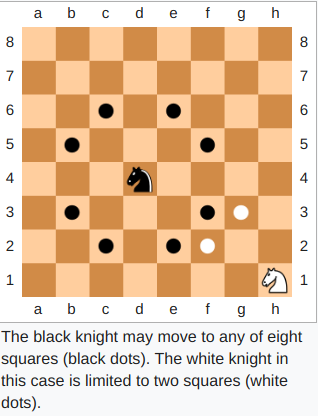
The
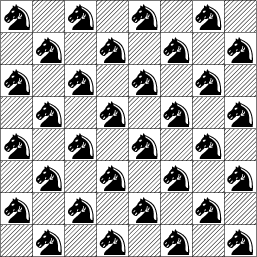
Determine the validity of
Hints
A possible brute force solution generates a list of all knight coordinates on the board, and then checks their pairwise consistency. Unlike for
Implementation
In Racket, implement the function
(valid? board)where board is a list of lists representing an arbitrarily sized board containing binary values, where 1 denotes a knight and 0 an empty cell; The function returns #t if and only if no knight threatens another one. Your file should be called knights.rkt and provide the valid? function.
Examples
(valid? ‘((1 0 0 0)
          (0 0 0 1)
          (1 0 0 0)
          (0 1 0 0)))
#t

(valid? '((0 1 0 0)
          (0 0 0 1)
          (1 0 0 0)
          (0 0 1 0)))
#f
Exam Solution
#lang racket

(provide valid?)

(define (generate-coords-row row offset row-id)
  (if (null? row)
      '()
      (if (eq? (car row) 1)
          (cons (cons row-id offset) (generate-coords-row (cdr row) (+ offset 1) row-id))
          (generate-coords-row (cdr row) (+ offset 1) row-id))))

(define (generate-coords-board board offset)
  (if (null? board)
      '()
      (append (generate-coords-row (car board) 0 offset) (generate-coords-board (cdr board) (+ offset 1)) )))

(define (valid-pair? coord1 coord2)
  (let ((absx (abs (- (car coord1) (car coord2))))
        (absy (abs (- (cdr coord1) (cdr coord2)))))
       (cond ((and (eq? absx 1) (eq? absy 2)) #f)
             ((and (eq? absx 2) (eq? absy 1)) #f)
             (#t #t))))

(define (valid-coord? coord coords)
  (cond ((null? coords) #t)
        ((valid-pair? coord (car coords)) (valid-coord? coord (cdr coords)))
        (#t #f)))

(define (valid-coords? coords)
  (cond ((null? coords) #t)
        ((valid-coord? (car coords) (cdr coords)) (valid-coords? (cdr coords)))
        (#t #f)))

(define (valid? board)
  (let ((coords (generate-coords-board board 0)))
    (valid-coords? coords)))
3. Haskell Main Task (15 points)
Pretty-print Binary Numbers
The goal of this assignment is to implement a program that reads a positive integer from standard input, converts it into its binary representation, and displays this representation as a text image. Each digit (i.e.,
Implement a program that works as follows:
- Display a message
Enter integer:. - Let the user enter an integer
(you may assume only valid inputs). - Convert
into its binary representation. - Display the binary representation using the above text-images. The particular digits must be separated by a column consisting of the character
'.'.
Below you can see an example run were the user enters the number 12.
Enter integer:
12
...#....#..##...##.
..##...##.#..#.#..#
...#....#.#..#.#..#
...#....#..##...##.
Implementation
Your program should be called Binary.hs. The text images of digits
    type Img = [String]

    zero :: Img
    zero = [".##.",
            "#..#",
            "#..#",
            ".##."]

    one :: Img
    one =  ["...#",
            "..##",
            "...#",
            "...#"]
You can display lines by putStrLn.
Exam Solution
type Img = [String]

empty :: Img
empty = replicate 4 ""

zero :: Img
zero = [".##.",
        "#..#",
        "#..#",
        ".##."]

one :: Img
one =  ["...#",
        "..##",
        "...#",
        "...#"]

concat2Img :: Img -> Img -> Img
concat2Img = zipWith (\s t -> s ++ "." ++ t)

concatImgs :: [Img] -> Img
concatImgs (im:ims) = foldl concat2Img im ims
concatImgs _ = empty

numToStr :: Int -> Int -> String
numToStr n radix = if  n < radix then [chars !! n]
                   else numToStr d radix ++ [chars !! r]
                 where chars = ['0'..'9'] ++ ['A'..'F']
                       d = n `div` radix
                       r = n `mod` radix

binToImgs :: String -> [Img]
binToImgs = map (\c -> case c of
                         '0' -> zero
                         '1' -> one)

genSol :: Int -> String
genSol n = unlines strs
        where strs = concatImgs $ binToImgs $ numToStr n 2

main :: IO ()
main = do putStrLn "Enter integer:"
          n <- read <$> getLine
          let bin = numToStr n 2
          let ims = binToImgs bin
          mapM_ putStrLn $ concatImgs ims